



The World Ahead 2027: What The Economist’s Outlook Means for Investors

The World Ahead 2027: What The Economist’s Outlook Means for Investors
By StockMarketHub Editorial Desk
Every November, The Economist publishes The World Ahead, its annual look at the themes it expects to shape the coming year. The 2027 edition, announced on November 17, frames the year as the start of a “post-Trump era” in US politics, with editor Tom Standage arguing that the exit will be loud rather than quiet. Politics aside, the list is a useful checklist for anyone who invests or trades, because most of its ten themes feed straight into interest rates, energy prices, earnings and risk appetite.
The print edition arrives with The Economist’s weekly issue on November 21, and a standalone version goes on sale on November 26. Here is what stands out for market participants, and what it could mean for Indian investors.
The ten themes at a glance
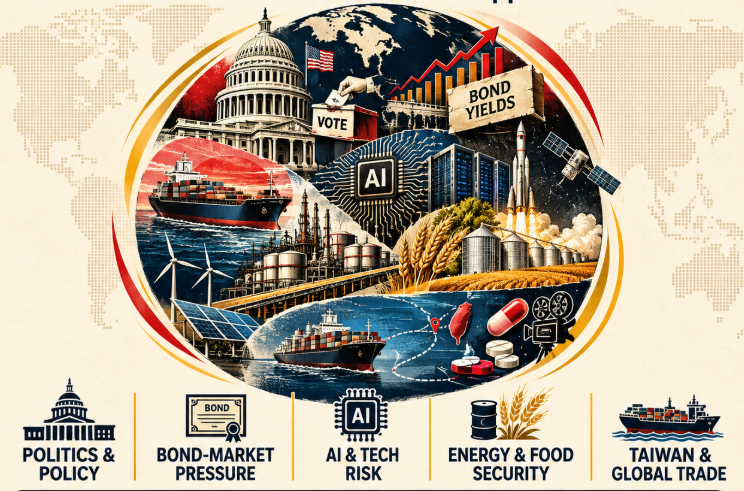
According to coverage of the launch, the themes are: the post-Trump era in American politics; the fallout from the war with Iran; a new global temperature record; growing pushback against AI; the populist right in Europe, including the prospect of Marine Le Pen winning power in France; pressure on bond markets; the Taiwan question; the “Ozempic effect” on consumers and pharma; cheaper space launches; and a reboot of Hollywood. Below we focus on the ones with the clearest market links.
1. Bond markets under pressure
The Economist points to heavy government debt and rising bond yields as a major risk for 2027. For equity investors this matters because government bond yields act as the benchmark for valuing everything else. When yields climb, future profits are discounted at a higher rate, which tends to hit expensive growth stocks hardest. It can also draw money away from emerging markets toward safer, higher-yielding Western bonds.
For India, the transmission channels to watch are foreign portfolio flows, the rupee, and the 10-year government bond yield, which influences bank stocks and borrowing costs across the economy.
2. AI: boom, backlash and risk
The magazine highlights a growing pushback against artificial intelligence, covering financial, political and cybersecurity risks. After several years in which AI-linked companies drove a large share of global index gains, a sharp change in sentiment could matter well beyond the tech sector. Indian investors should keep an eye on IT services companies, whose revenues depend on how global clients spend on technology, as well as on any concentration of AI-related names in their mutual fund or ETF holdings.
3. The Iran war’s aftermath: energy and food
The outlook expects the consequences of the war with Iran to linger, with changes in the regional balance, shipping and energy routes, and risks to food security. India imports the large majority of its crude oil, so oil price swings feed directly into inflation, the trade deficit and the rupee. Sectors such as oil marketing, aviation, paints and chemicals are traditionally the most sensitive to crude.
4. Record heat and climate shocks
Another theme is a new temperature record, with droughts, wildfires and heat waves alongside faster growth in renewable energy. For markets, climate shows up as farm output and food inflation, electricity demand, insurance costs and investment in clean energy. A weak monsoon or extreme heat can move rural demand, FMCG volumes and inflation expectations.
5. Political and geopolitical risk
Two further themes carry risk premiums: the possibility of a populist-right victory in France, with implications for the European Union, and the question of Taiwan. The Taiwan issue matters to investors mainly because of the global semiconductor supply chain, on which electronics, autos and AI hardware all depend.
6. Sector themes worth a watchlist
- Weight-loss drugs: the “Ozempic effect” could change food, beverage and healthcare spending patterns.
- Cheaper space launches: private space companies and ideas such as orbital data centres may open new investment themes.
- Hollywood’s reboot: shifting formats and independent filmmaking could reshape media and streaming economics.
What should investors do with this?
Outlook reports are a map of risks, not a trading signal. A few sensible, educational takeaways:
- Do not trade the headline. Size every position by what you can afford to lose. Our Position Size Calculator and Risk/Reward Calculator help you set that before you enter a trade.
- Diversify across assets. If several of these risks hit together, a portfolio concentrated in one theme will feel it most.
- Stay consistent for the long term. Volatility is normal, and a disciplined monthly SIP smooths out entry prices. Try our SIP Calculator to see how steady investing compounds.
- Track a few indicators: the US 10-year yield, crude oil prices, the USD/INR rate and the India VIX give an early read on stress.
Disclaimer: This article is for educational and informational purposes only and is not investment advice. Please consult a SEBI-registered advisor before making financial decisions.
Source: Based on and press coverage of its launch.