



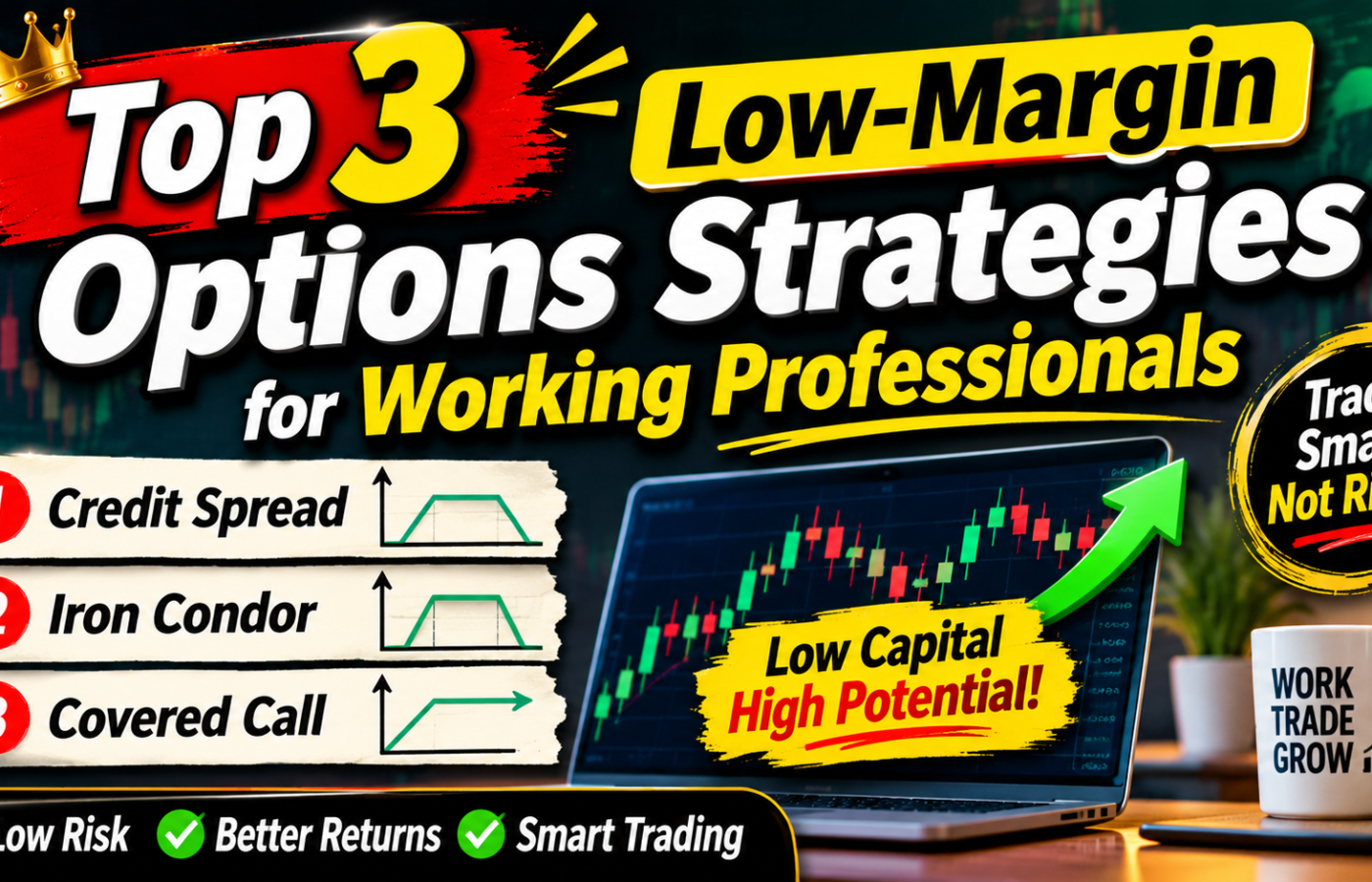
Top 3 Low-Margin Options Strategies for Working Professionals

Top 3 Low-Margin Options Strategies for Working Professionals
Trading can be difficult when you have a full-time job. You cannot watch the Nifty chart every five minutes, react to every candle, or spend the entire day managing a trade.
That is why many working professionals look for low-margin options strategies that offer defined risk and do not require constant screen time.
The good news is that options trading does not always have to mean buying expensive Calls and Puts or taking large risks. With the right strategy, planning, and risk management, traders can structure positions based on their market view and available capital.
Here are three popular options strategies that working professionals can study and understand.
Disclaimer: This article is for educational purposes only and does not provide investment or trading advice. Options strategies involve risk, and actual margin requirements can vary depending on the broker, underlying instrument, volatility, and current exchange rules.
1. Bull Call Spread: A Strategy for a Moderately Bullish Market

A Bull Call Spread is designed for traders who believe the market may move higher but do not want to take unlimited premium exposure.
The strategy generally involves:
- Buying a Call option at one strike price.
- Selling another Call option at a higher strike price with the same expiry.
The premium received from the sold Call can help reduce the overall cost of the position.
Why It May Suit Working Professionals
The biggest advantage is that your potential risk and potential reward can be understood before entering the trade.
Instead of watching every small market movement, you can plan the trade around:
- Your market view.
- Maximum acceptable loss.
- Expected profit range.
- Expiry date.
However, because the upside is limited, a very large market rally may not provide unlimited gains.
2. Bear Put Spread: A Strategy for a Moderately Bearish View
The Bear Put Spread works on a similar principle but is designed for a bearish market view.
It generally involves:
- Buying a Put option.
- Selling another Put option at a lower strike price with the same expiry.
Selling the second Put can reduce the net premium paid for the position.
Why This Strategy Can Be Easier to Manage
For a working professional, having a clearly defined maximum risk can be helpful.
You know the basic structure of the trade before entering it, rather than buying a naked Put and hoping the market continues to fall.
But remember, the strategy still requires a correct market view. If the market does not move as expected, the position can lose money.
3. Iron Condor: A Range-Bound Market Strategy
An Iron Condor is a more advanced options strategy generally used when a trader expects the market to stay within a defined range.
The strategy combines Call and Put spreads to create a position with limited risk and limited potential profit.
In simple terms, the trader is trying to structure a position around the idea that the market may remain between two important price zones.
Why Working Professionals Should Be Careful
An Iron Condor may require less frequent monitoring than very short-term option buying, but it is not a completely hands-off strategy.
A strong market move can affect the position quickly. Traders should understand:
- The break-even levels.
- Maximum possible loss.
- Adjustment rules.
- The effect of volatility changes.
For beginners, it is important to understand the strategy thoroughly before using real money.
Low Margin Does Not Mean Low Risk
This is one of the most important lessons in options trading.
A strategy that appears to require less capital can still carry significant risk. Margin requirements may change, and losses can occur quickly during volatile market conditions.
Before entering any strategy, ask yourself:
- What is my maximum possible loss?
- How much capital can I realistically risk?
- Do I understand every leg of the strategy?
- What will I do if the market moves strongly against me?
Never choose a strategy only because it appears to require less margin.
A Simple Approach for Working Professionals
If you have limited time to watch the market, focus on planning rather than reacting.
Before placing a trade:
- Decide your market view.
- Choose a strategy that matches that view.
- Understand the maximum risk.
- Set clear rules for managing the position.
- Avoid checking the market emotionally every few minutes.
The goal should not be to trade every day.
Sometimes, the best decision for a busy trader is to wait for a market condition they actually understand.
Final Thoughts
Options trading can offer different ways to participate in the market, but no strategy guarantees profits.
For working professionals, the biggest advantage may come from choosing strategies with defined risk, clear rules, and manageable positions rather than chasing fast intraday moves.
Whether you study a Bull Call Spread, Bear Put Spread, or Iron Condor, take time to understand how the strategy works before putting real capital at risk.
In trading, having less time in front of the screen does not have to be a disadvantage. With proper planning and risk management, it can actually encourage you to make more disciplined decisions.
The goal is not to find a strategy that makes money every day. The goal is to find a trading approach that fits your time, knowledge, and risk tolerance.