
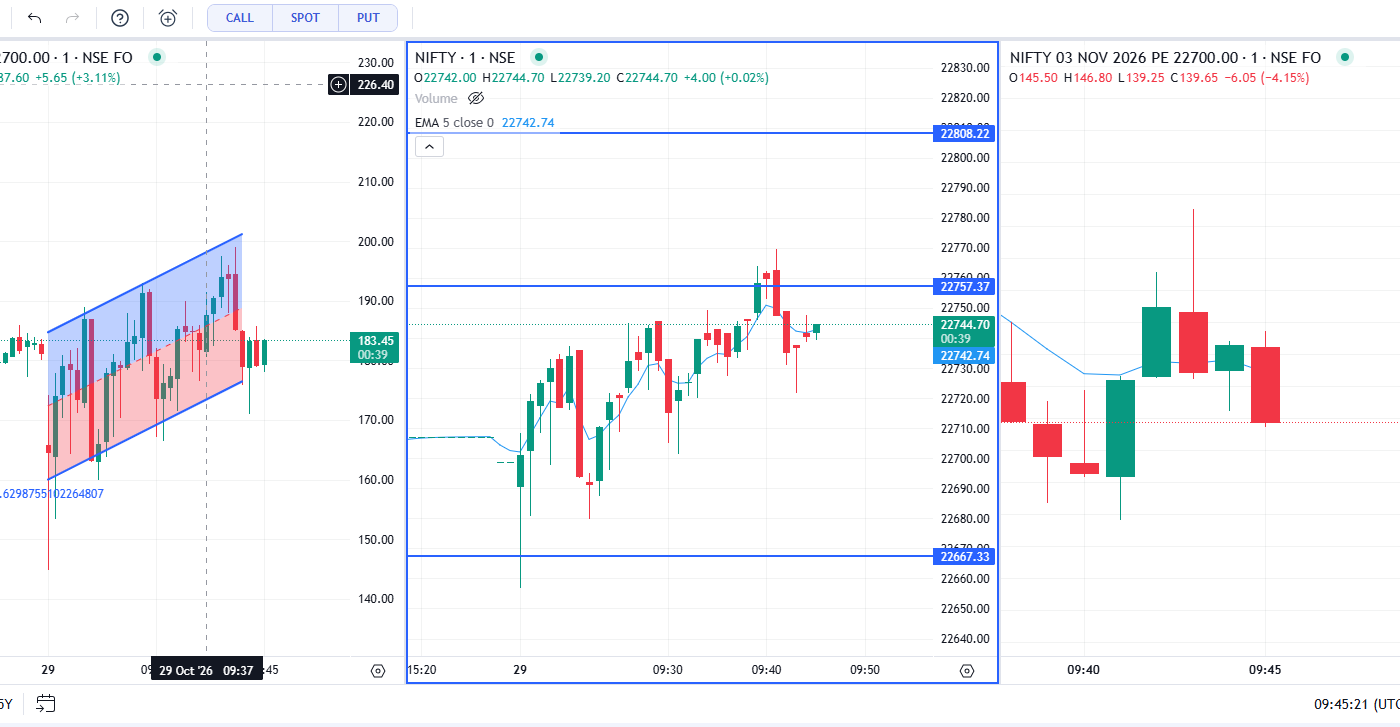
NIFTY Spot at 22,744 – CE and PE Are Fighting, and One Is Clearly Winning

The NIFTY options market can look like a battlefield. Call Option (CE) buyers want the index to move higher, while Put Option (PE) buyers look for a decline.
Meanwhile, option sellers may benefit when premiums fall, provided the market moves and volatility behave in their favor.
When NIFTY trades around 22,744, the key question is not simply whether the index is rising or falling. Traders need to understand which side is gaining strength, whether option premiums are confirming the move, and whether the market is showing signs of a genuine breakout or a temporary reversal.
The important point: NIFTY spot at 22,744 alone does not prove that CE or PE is winning. The answer depends on price action, option premiums, changes in open interest, volume, and implied volatility.
In this article, we will examine how to read the battle between CE and PE and identify the signals that can help traders understand market direction.
1. Why the NIFTY 22,744 Level Matters
The 22,744 level is the reference point for this analysis. Around this price, traders may monitor nearby strikes such as 22,700, 22,750, and 22,800, depending on the available option chain and expiry.
These strikes can help traders compare the behavior of calls and puts around the current spot price.
For example:
- If NIFTY moves above a nearby resistance zone and holds there, bullish momentum may be developing.
- If NIFTY fails to cross resistance and moves lower, sellers may be gaining control.
- If NIFTY remains trapped in a narrow range, both CE and PE buyers may face premium decay.
- If price breaks a level but quickly reverses, the breakout may lack confirmation.
A single spot price is only a snapshot. The direction and quality of the next move matter more than the number itself.
2. How to Identify Whether CE Buyers Are Winning
Call options generally benefit from a rise in the underlying index, all else being equal. However, a rising NIFTY does not guarantee that every CE will gain value because time decay, implied volatility, and the strike’s distance from spot also influence premiums.
Look for several signals together.
Signal 1: NIFTY is moving higher
A sequence of higher highs and higher lows can indicate improving short-term price momentum.
Signal 2: CE premiums are increasing
If relevant call premiums rise alongside NIFTY, the options market may be confirming the upward move.
Signal 3: Resistance is breaking
A move above a clearly defined resistance zone, followed by sustained trading above it, is generally more meaningful than a brief spike.
Signal 4: Volume supports the move
Strong trading activity can add context to a breakout, although volume alone cannot guarantee continuation.
When these signals align, CE buyers may have the stronger directional setup. Traders should still define their stop-loss and avoid entering after the move has already extended too far.
3. How to Identify Whether PE Buyers Are Winning
Put options generally benefit from a decline in the underlying index, all else being equal. A falling NIFTY can increase PE premiums, but the result also depends on implied volatility, time decay, and the option’s strike.
Watch for these signs:
- NIFTY breaks below a support zone and struggles to recover.
- Relevant PE premiums rise as the index declines.
- Price forms lower highs and lower lows.
- Selling pressure continues after a failed attempt to reclaim support.
- The move is supported by meaningful market activity.
When these conditions appear together, PE buyers may have the stronger directional opportunity.
However, traders should distinguish between a genuine bearish move and a brief decline followed by a sharp recovery. Buying puts after a large fall can be risky if the premium has already expanded substantially.
4. The Real Battle: Spot Price Versus Option Premiums
One of the most useful ways to analyze CE and PE is to compare the index movement with changes in the relevant option premiums.
| NIFTY movement | CE premium | PE premium | Possible interpretation |
|---|---|---|---|
| Rising | Rising | Falling | Bullish price action may be strengthening |
| Falling | Falling | Rising | Bearish price action may be strengthening |
| Rising | Falling | Falling | Time decay or falling volatility may be outweighing directional gains |
| Falling | Rising | Falling | Put-side strength may be fading, or volatility may be changing |
| Sideways | Falling | Falling | Premium decay may be affecting both option buyers |
| Sideways | Rising | Rising | Implied volatility may be increasing |
These are general interpretations, not guaranteed signals. Different strikes and expiries can behave differently, particularly when one option is far out of the money or has very little time remaining.
The strongest analysis combines spot movement with premium changes rather than relying on either one in isolation.
5. Why CE and PE Can Both Lose Money
Many new options traders assume that if NIFTY rises, CE buyers must profit, and if NIFTY falls, PE buyers must profit. This is not always true.
An option premium is influenced by several factors:
- Underlying price: The direction and magnitude of the NIFTY move.
- Time decay: The reduction in time value as expiry approaches.
- Implied volatility: Changes in the market’s expected future movement.
- Strike price: How far the option is from being at the money.
- Remaining time: How much time the option has left before expiry.
Imagine NIFTY moves slightly higher, but the call option loses value because time decay and a drop in implied volatility outweigh the benefit of the index move. A similar effect can occur with puts during a small decline.
This is why directional accuracy alone is not enough. Option buyers also need the move to be sufficiently large and timely relative to the premium paid.
6. How Open Interest Helps Explain the Battle
Open interest (OI) represents outstanding option contracts that have not been closed or settled. Traders often use it to study positioning at different strikes.
For example, significant call open interest near a resistance area may indicate an important level to monitor. Substantial put open interest near a support area may also attract attention.
But open interest must be interpreted carefully.
- Rising OI does not automatically mean that option sellers are winning.
- Falling OI can reflect positions being closed rather than a new directional view.
- OI alone does not identify every participant’s intention.
- The change in OI, premium movement, spot price, and volume should be evaluated together.
A call premium rising while NIFTY rises and call OI also increases can be consistent with fresh positions being added. However, OI data alone cannot establish whether buyers or sellers initiated the activity.
The same caution applies to puts.
7. A Practical Framework for the 22,744 Spot Zone
For traders studying a chart around 22,744, the following framework can help organize the analysis without pretending to know the next move in advance.
Scenario A: Bullish confirmation
Watch for NIFTY to move above a nearby resistance level, hold above it, and show strengthening CE premiums.
A possible bullish setup would require a defined entry trigger, an invalidation level, and a position size that fits the trader’s risk limit.
Scenario B: Bearish confirmation
Watch for NIFTY to break below a nearby support level, fail to recover it, and show strengthening PE premiums.
A bearish setup should also include a clear stop-loss and an exit plan if the index reclaims support.
Scenario C: Range-bound conditions
If NIFTY repeatedly moves between support and resistance without a sustained breakout, directional option buying may become difficult.
In such conditions, both CE and PE premiums can lose value through time decay, particularly near expiry. Traders should avoid forcing a directional view when the evidence is unclear.
Important: The levels around 22,700, 22,750, and 22,800 are nearby reference strikes for organizing the analysis, not verified support or resistance levels. Actual technical levels must be identified from the chart and current option-chain data.
8. Common Mistakes Traders Make During the CE-versus-PE Battle
Buying after a large candle
A strong move can attract traders who fear missing out. By the time they enter, however, the premium may already reflect much of the move.
Better approach: Wait for a valid setup and assess the distance to the stop-loss before entering.
Treating OI as a guaranteed prediction
High call OI does not mean NIFTY must fall, and high put OI does not mean it must rise.
Better approach: Combine OI with price action, premium changes, and volume.
Ignoring implied volatility
A trader can correctly predict the direction but still lose money if volatility falls or the move is too small.
Better approach: Consider the option’s premium and volatility environment before buying.
Risking too much on one side
Taking an oversized CE or PE position can quickly damage an account when the market reverses.
Better approach: Predefine risk, calculate position size, and never use a larger position simply because a trade appears obvious.
Trading without an invalidation level
If you do not know what would prove your trade idea wrong, it becomes easy to hold a losing position for too long.
Better approach: Decide in advance where the setup is invalidated and follow your risk plan.
9. What Traders Should Check Before Choosing CE or PE
Before deciding which side has the stronger setup, review the following:
-
Is NIFTY trending or moving sideways?
-
Has a meaningful support or resistance level been broken?
-
Are the relevant CE and PE premiums confirming the spot move?
-
What do changes in open interest suggest when combined with price and volume?
-
Is implied volatility rising or falling?
-
How much time remains until expiry?
-
Is the potential reward worth the risk?
-
Where will the trade be exited if the analysis is wrong?
If these signals conflict, the market may not offer a clear directional opportunity. Waiting for confirmation is also a trading decision.
Final Thoughts: Who Is Winning at NIFTY 22,744?
When NIFTY is around 22,744, the battle between CE and PE should be judged through evidence—not assumptions.
If NIFTY rises, relevant CE premiums strengthen, and price action confirms a breakout, the bullish side may be gaining control. If NIFTY falls, PE premiums strengthen, and support breaks convincingly, the bearish side may have the advantage.
If the index remains range-bound and premiums decline, neither group of option buyers may have a favorable setup.
Without verified, time-matched option-chain data for the stated 22,744 snapshot, it would be misleading to declare one side the clear winner. The best approach is to combine spot price, premium movement, open interest, volatility, and risk management before making a decision.
Disclaimer: This article is for educational purposes only and is not financial advice. NIFTY options involve substantial risk, and option buyers can lose the entire premium paid. Market conditions change rapidly; verify current NSE data and your broker’s option chain before making trading decisions.