

Every Minute on Expiry Day Costs PE Holders Money – Here Is the Proof

Expiry day can be one of the most challenging sessions for options traders. The market may move only a few points, yet the premium of a put option can change rapidly. For traders who buy PE options, waiting for the expected move can become expensive when the market does not move in their favour.
This is where time decay becomes especially important.
A put option buyer is not only making a prediction about the market’s direction. They are also dealing with a deadline. As the option approaches expiry, the time available for the expected move to happen becomes shorter. If the underlying index remains above the strike price or moves in the opposite direction, the option’s premium may decline significantly.
But does every minute on expiry day always cost PE holders money? Not exactly. The real explanation comes from understanding how options are priced and how time decay interacts with market movements.
Why Expiry Day Is Different for PE Buyers
A put option gives its buyer the right, but not the obligation, to sell the underlying asset at the specified strike price, subject to the contract’s terms.
Before expiry, an option’s premium generally consists of two components:
- Intrinsic value: The value the option has if it is in the money.
- Time value: The additional value associated with the possibility of a favourable move before expiry.
For a standard index put option, intrinsic value at a given moment is based on how far the index is below the strike price. If the index is above the strike price, the put is out of the money and has no intrinsic value.
As expiry approaches, there is less time for the market to move favourably. Consequently, the time value of an option tends to decrease, all else being equal.
On expiry day, this process can become particularly noticeable because only a limited amount of time remains.
The Proof: How Time Decay Can Reduce a PE Premium
Consider a hypothetical example of a NIFTY put option bought on expiry day.
Imagine a trader purchases a PE option for ₹40. The market then moves sideways instead of falling as expected. With less time remaining, the option premium may decline.
Here is an illustrative example of how the premium could change:
| Time remaining | Illustrative PE premium |
|---|---|
| 11:00 AM | ₹40 |
| 12:00 PM | ₹32 |
| 1:00 PM | ₹24 |
| 2:00 PM | ₹15 |
| 2:45 PM | ₹7 |
In this example, the premium falls from ₹40 to ₹7, a decline of 82.5%.
However, these figures are hypothetical, not verified historical market data. They demonstrate how a premium could decline under unfavourable conditions; they do not prove that a particular NIFTY PE loses a fixed amount every hour.
Actual premiums depend on the index level, strike price, volatility, liquidity, and time remaining. A sharp downward move in the index can cause a PE premium to rise even on expiry day.
Why Time Decay Can Accelerate Near Expiry
Time decay is often associated with theta, one of the important measures of option sensitivity.
Theta estimates how much an option’s theoretical value may change as time passes, assuming other pricing factors remain unchanged. For many options, the rate of time decay becomes more pronounced as expiry approaches, particularly when the option is near the money.
This is why expiry-day buyers may find that a trade loses value while they wait.
Suppose a trader buys a PE expecting NIFTY to fall by 50 points. If the index stays within a narrow range for the next 30 minutes, the option may lose time value. If implied volatility also declines, the premium could fall further.
The trader’s market prediction might eventually prove correct, but the move may arrive too late to offset the premium lost while waiting.
This is one of the biggest challenges of buying options close to expiry: being correct about direction is not enough if the expected move does not happen in time.
What Happens When NIFTY Moves Against a PE Buyer?
Time decay is only part of the story. The underlying index’s movement can have an even greater effect on an option’s premium.
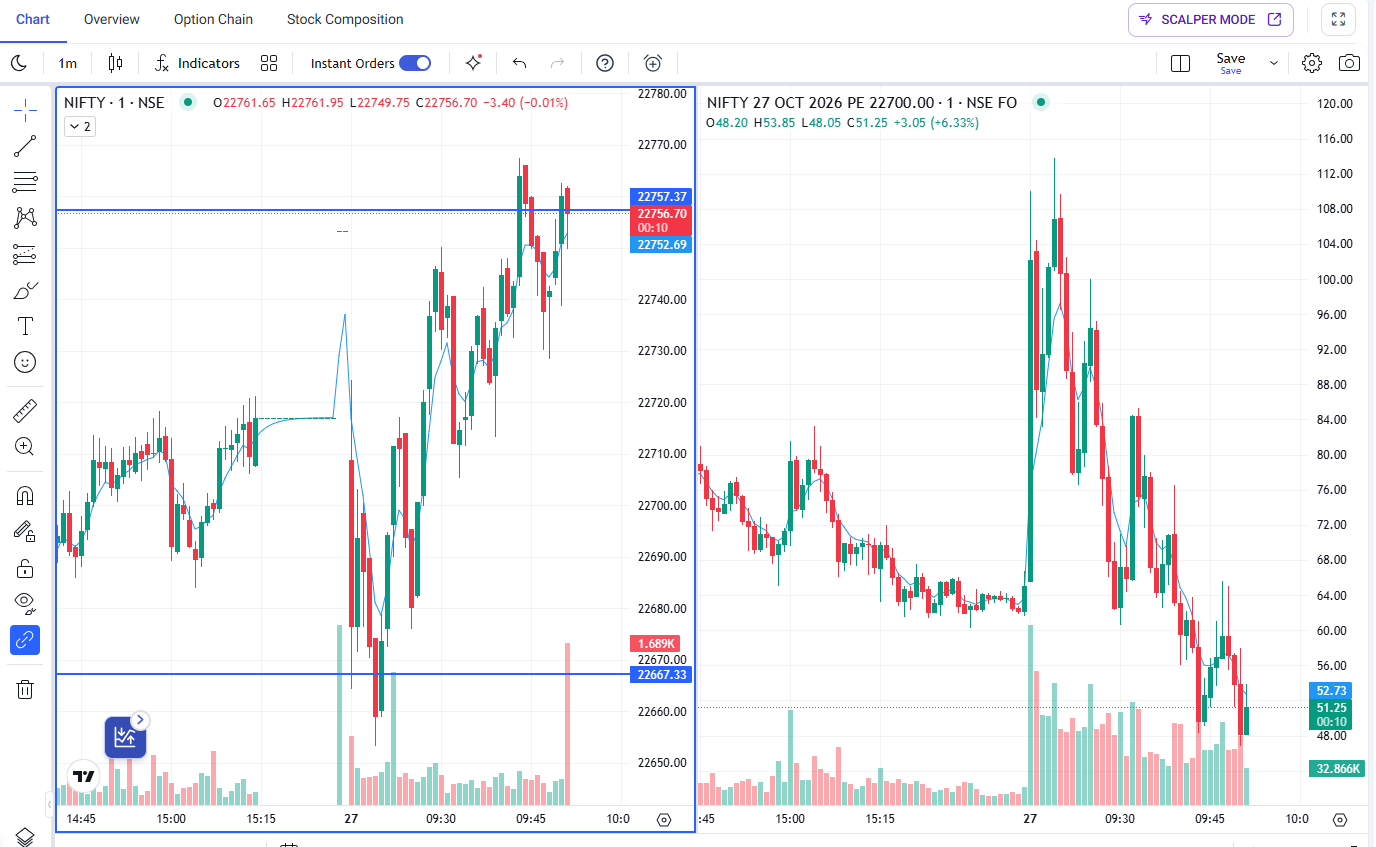
When NIFTY rises, a put option generally loses value, all else being equal. The option may move further out of the money, reducing the likelihood that it will finish with intrinsic value.
For example, a trader holding a NIFTY PE during a strong market recovery may experience two pressures:
- The index moves upward, reducing the put option’s value.
- Time passes, leaving less opportunity for the index to fall before expiry.
If implied volatility also drops, the premium may come under additional pressure.
These factors can combine to create a sharp decline. Nevertheless, they do not always move in the same direction, and their individual effects cannot be determined from the premium alone.
Why Out-of-the-Money PE Options Can Be Especially Risky
Out-of-the-money put options can look attractive because their premiums may be relatively low. Some traders buy them in the hope of making a large percentage return from a sudden market fall.
The risk is that these options may expire worthless if the underlying index finishes above the strike price.
As expiry approaches, an out-of-the-money option has limited time to move into the money. If the anticipated fall does not occur, its remaining time value may diminish rapidly.
A low premium does not necessarily mean a low-risk trade. Traders should consider the probability of the expected move, the available time, liquidity, and the possibility of losing the entire premium paid.
Does Every Minute Really Cost PE Holders Money?
The title makes a powerful point, but it needs an important qualification.
Every passing minute does not automatically reduce a put option’s premium. The premium can rise if NIFTY falls sharply or if implied volatility increases enough to offset time decay.
Theta is a theoretical measure, not a guarantee of the option’s next price movement. Option premiums respond to several factors at once.
The more accurate lesson is that time generally works against an option buyer when other factors remain unchanged. On expiry day, the limited time remaining can make this effect more noticeable.
For a PE buyer, the most unfavourable combination may be a sideways or rising market, declining implied volatility, and rapidly diminishing time value.
How PE Buyers Can Manage Expiry-Day Risk
Expiry-day trading requires a clear plan. No strategy can remove risk, but traders can take practical steps to avoid making decisions based only on hope.
1. Define the Trade Before Entering
Identify why the put option is being purchased. Is there a confirmed breakdown, a rejection from resistance, or another clearly defined setup?
Avoid buying a PE solely because NIFTY has already fallen sharply. A large move may be followed by a reversal.
2. Set a Maximum Acceptable Loss
Decide in advance how much capital can be risked on the trade. Position size should reflect that limit and the possibility of rapid price changes.
A stop-loss can help control risk, but execution is not guaranteed at the exact chosen price during fast markets.
3. Avoid Waiting Without a Valid Reason
If the original trading setup fails, reassess the position rather than holding it simply because a recovery might occur.
Expiry-day options have limited time remaining. A delayed move can materially change the trade’s risk and reward.
4. Check the Option Premium, Not Just the Index
NIFTY’s movement does not tell the entire story. Monitor the option’s own chart, bid-ask spread, liquidity, and changes in implied volatility.
A small move in the index can sometimes produce a large percentage change in a low-priced option.
5. Do Not Chase Losses
If a PE premium falls sharply, buying another option immediately to recover the loss can lead to impulsive decisions.
Taking a break and reviewing the trade may be more useful than increasing exposure without a fresh setup.
6. Consider Whether the Trade Is Worth Taking
Not every market movement creates a good opportunity. If the expected move is small, time is limited, or the potential loss is unacceptable, staying out of the trade is a valid decision.
How to Verify the Claim With Real Market Data
To establish whether a particular PE lost value as expiry approached, use historical index and option data from the same contract and session.
A meaningful analysis should include:
- The exact trading date and expiry.
- The option’s strike price and whether it was in, at, or out of the money.
- The premium at specific timestamps.
- The NIFTY index level at those same timestamps.
- Implied volatility, where available.
- The premium’s absolute and percentage change over the measured period.
For example, if a PE premium falls from ₹40 to ₹20, the decline is 50%. The calculation is:
Percentage decline = (Entry premium − Later premium) ÷ Entry premium × 100
Using the example:
[
\frac{40-20}{40}\times100=50%
]
This calculation proves the percentage change between those two observations. To show that time decay caused the decline, however, the analysis must also account for changes in NIFTY, implied volatility, and other pricing factors.
Without verified timestamped data, a specific claim about the premium falling by a particular percentage should be treated as an illustration rather than proof.
Final Thoughts
Expiry day can be unforgiving for put option buyers. When the expected fall does not happen quickly, the passage of time can reduce the option’s value. If NIFTY rises or implied volatility declines at the same time, the premium may fall even more sharply.
The central lesson is not that every minute guarantees a loss. It is that an option buyer has limited time for the expected move to occur, and that deadline must be part of the trading decision.
Before buying a PE on expiry day, understand the strike price, remaining time, volatility, and maximum potential loss. Never assume that a cheap option will become profitable simply because the market might eventually move in the expected direction.
In options trading, timing matters just as much as direction—and risk management matters more than chasing a quick profit.
Disclaimer: This article is for educational purposes only and is not investment advice or a recommendation to trade. Options are high-risk instruments, and buyers may lose the entire premium paid. The numerical example in this article is hypothetical and should not be interpreted as verified market evidence.