

Nifty Expiry Tomorrow: Why a ₹109 ATM Call Has Zero Real Value

Nifty Expiry Tomorrow: Why a ₹109 At-the-Money Call Has Almost No Real Value Today
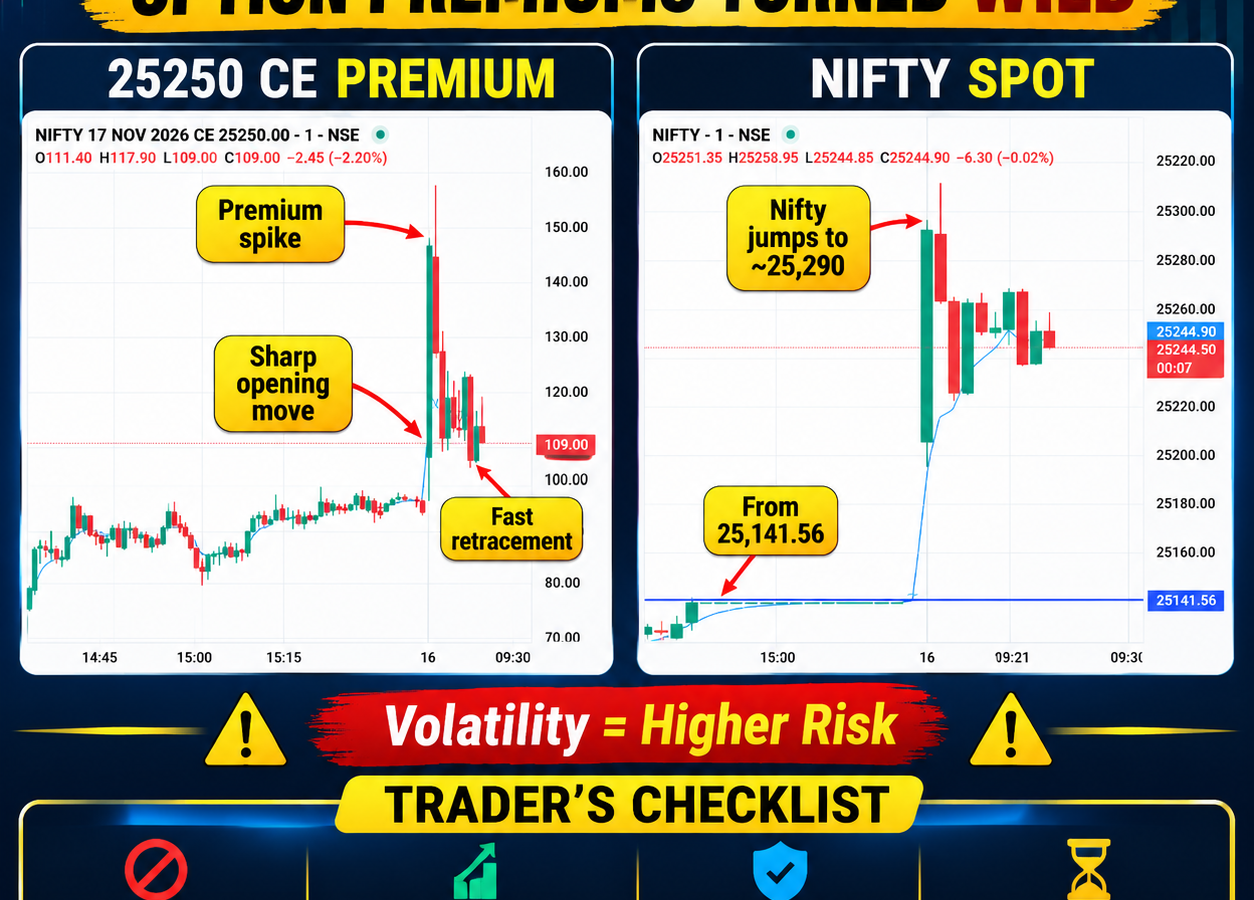
Imagine looking at the Nifty option chain and finding an At-the-Money (ATM) Call trading at ₹109, even though the contract is expiring tomorrow.
At first glance, ₹109 may look like a reasonable option premium. A trader might believe that a small upward move in Nifty could quickly turn this option into a profitable trade.
But there is something important that every option buyer should understand: an option premium is not the same as its real or intrinsic value.
When expiry is just one day away, most of an ATM option’s premium can consist of time value rather than intrinsic value. If Nifty does not move quickly enough, that premium can disappear much faster than expected.
Let’s understand why a ₹109 ATM Call can be particularly risky for option buyers when Nifty expiry is tomorrow.
1. What Does an ATM Call Actually Mean?
An At-the-Money Call option is a Call whose strike price is approximately equal to the current Nifty spot or relevant index level.
For example:
- Nifty spot: 26,000
- ATM Call strike: 26,000
- Call premium: ₹109
- Expiry: Tomorrow
The option gives its buyer the right to benefit from an upward move in Nifty, subject to the contract’s terms.
However, the option does not automatically have ₹109 of intrinsic value.
Intrinsic value is calculated as:
Call Intrinsic Value = Maximum (Nifty Spot − Strike Price, 0)
In this example:
Nifty spot = 26,000
Strike price = 26,000
Intrinsic value = ₹0
Therefore, the entire ₹109 premium is time value at that moment, ignoring transaction costs and any pricing discrepancies.
This is the first important lesson: an ATM option can have a substantial market premium while having zero intrinsic value.
2. Why Is the ₹109 Premium So Sensitive Before Expiry?
Options have two major components:
- Intrinsic value
- Extrinsic value, which includes time value and the effect of implied volatility
For an ATM option, intrinsic value is generally zero or close to zero.
This means its premium is largely dependent on expectations about future price movement and volatility.
When expiry approaches, the time available for Nifty to make a favourable move becomes smaller.
This creates an important risk for option buyers.
Theta decay is the reduction in an option’s theoretical value as time passes, all else being equal.
The closer the contract gets to expiry, the more sensitive its remaining time value can become to the passage of time.
However, theta decay is not a fixed amount that disappears at the same rate every hour. It changes with volatility, moneyness, interest rates and the remaining time to expiry.
3. The Biggest Risk: Nifty Does Not Move
Consider a hypothetical situation.
A trader buys a Nifty 26,000 ATM Call at ₹109 when Nifty is trading around 26,000.
The trader expects Nifty to move higher.
But instead of rising, Nifty remains near the same level for several hours.
What happens?
The option buyer may start losing premium even though Nifty has not moved significantly.
Why?
Because the option has less time remaining to become profitable.
The market is effectively reducing the opportunity for the option to gain intrinsic value before expiry.
This is why sideways markets can be frustrating for option buyers.
You may be correct about the broader market direction, but if the expected move does not happen quickly enough, the option premium can decline.
4. What Happens When Nifty Moves in Your Direction?
Now consider another situation.
The trader buys the ATM Call at ₹109.
Nifty starts moving upward.
The option can gain value because:
- Its intrinsic value may increase.
- Its delta exposure creates sensitivity to the upward move.
- Changes in implied volatility can also influence its premium.
But there is no guarantee that the option will rise by a fixed amount for every point Nifty gains.
The premium depends on several factors, including delta, gamma, theta and implied volatility.
Near expiry, gamma can become particularly important for ATM options. It measures how quickly delta changes when the underlying index moves.
This means a relatively small movement in Nifty can change the option’s sensitivity significantly.
For an option buyer, a strong and timely upward move can help offset time decay. A slow or weak move may not be enough.
5. Why an ATM Option Can Lose Value Even When Your View Is Correct
This is one of the most misunderstood aspects of options trading.
Suppose you expect Nifty to rise before tomorrow’s expiry.
You buy a 26,000 Call.
Nifty eventually moves to 26,020.
Your market direction was correct.
However, your option premium may still disappoint you if the upward movement was too small or too slow to compensate for the reduction in time value and any fall in implied volatility.
This is particularly important when traders buy options after a sudden volatility spike.
If implied volatility falls, the premium can decline even when the underlying moves slightly in the expected direction.
Therefore, predicting the direction alone is not enough.
You must also consider the size and speed of the expected move.
6. The Role of Implied Volatility in a ₹109 ATM Call
Implied volatility (IV) represents the market’s expectations of future price fluctuations as reflected in option prices.
When IV rises, option premiums may increase, all else being equal.
When IV falls, option premiums may decrease.
This creates another challenge for expiry-day option buyers.
Imagine buying a ₹109 ATM Call when volatility is elevated because traders are expecting a major market move.
If the expected event passes and volatility drops, the option may lose value.
This is commonly called volatility crush.
A trader can therefore face two pressures:
- Time decay reduces the remaining extrinsic value.
- Falling implied volatility can reduce the premium further.
That is why checking IV before buying an option is important, particularly when expiry is close.
7. What Should Nifty Option Buyers Check Before Buying?
Before buying a short-dated ATM Call, consider the following factors.
Nifty price action: Is the index showing genuine upward momentum, or is it moving sideways?
Support and resistance: Is Nifty approaching a major resistance zone where buying momentum may slow?
Theta: How much time remains until expiry, and how sensitive is the option to time decay?
Implied volatility: Is the option premium elevated compared with its recent volatility conditions?
Delta and gamma: How sensitive is the option to an index movement, and how quickly might that sensitivity change?
Risk management: Where will you exit if the market does not behave as expected?
A disciplined trader studies these factors before entering a position instead of focusing only on the option premium.
8. A Simple Example: Understanding the ₹109 Premium
Let’s look at a hypothetical illustration.
| Particular | Value |
|---|---|
| Nifty Spot | 26,000 |
| Call Strike | 26,000 |
| Option Premium | ₹109 |
| Expiry | Tomorrow |
| Intrinsic Value | ₹0 |
| Extrinsic Value | ₹109 |
This example shows that the option’s entire premium is extrinsic value at the time of purchase.
If Nifty remains at 26,000 until expiry, the Call expires worthless.
If Nifty moves above 26,000, the option may develop intrinsic value.
At expiry, its intrinsic value is determined by the difference between the settlement value and the strike price, subject to the contract specifications.
The ₹109 paid by the buyer is therefore not guaranteed to be recovered.
The buyer needs the option’s expiry value to exceed the purchase cost, after considering applicable charges, to make a net profit.
9. The Biggest Mistake: Treating a Cheap-Looking Option as a Safe Trade
Many traders see an ATM option trading at ₹109 and assume that the risk is relatively small.
But the premium alone does not tell you whether an option is cheap or expensive.
An option priced at ₹109 can still be expensive relative to its remaining time, implied volatility and expected market movement.
Similarly, a higher-priced option is not automatically a bad trade.
The important question is whether the premium is justified by the probability and magnitude of the expected movement.
Never buy an option simply because its premium looks affordable.
Understand what you are paying for.
10. Final Thoughts: Time Is the Biggest Challenge for Expiry Buyers
A ₹109 ATM Call with expiry tomorrow is a useful example of how option pricing works.
Its premium may look substantial, but if the option is exactly ATM, its intrinsic value is zero.
The entire premium represents extrinsic value, which is exposed to changes in time and implied volatility.
For Nifty option buyers, this creates an important lesson:
You are not just predicting where Nifty will move. You are also predicting how quickly it will move.
A correct directional view may not be enough if the index moves too slowly.
Before buying an expiry-near option, study its intrinsic value, time value, theta, delta, gamma and implied volatility.
Most importantly, decide your maximum acceptable loss before entering the trade.
In options trading, protecting capital is more important than chasing every market movement.
Disclaimer: This article is for educational and informational purposes only. It is not investment advice or a recommendation to buy or sell any financial instrument. Options trading involves substantial risk. The ₹109 example is hypothetical and does not represent a verified live Nifty option quote.