

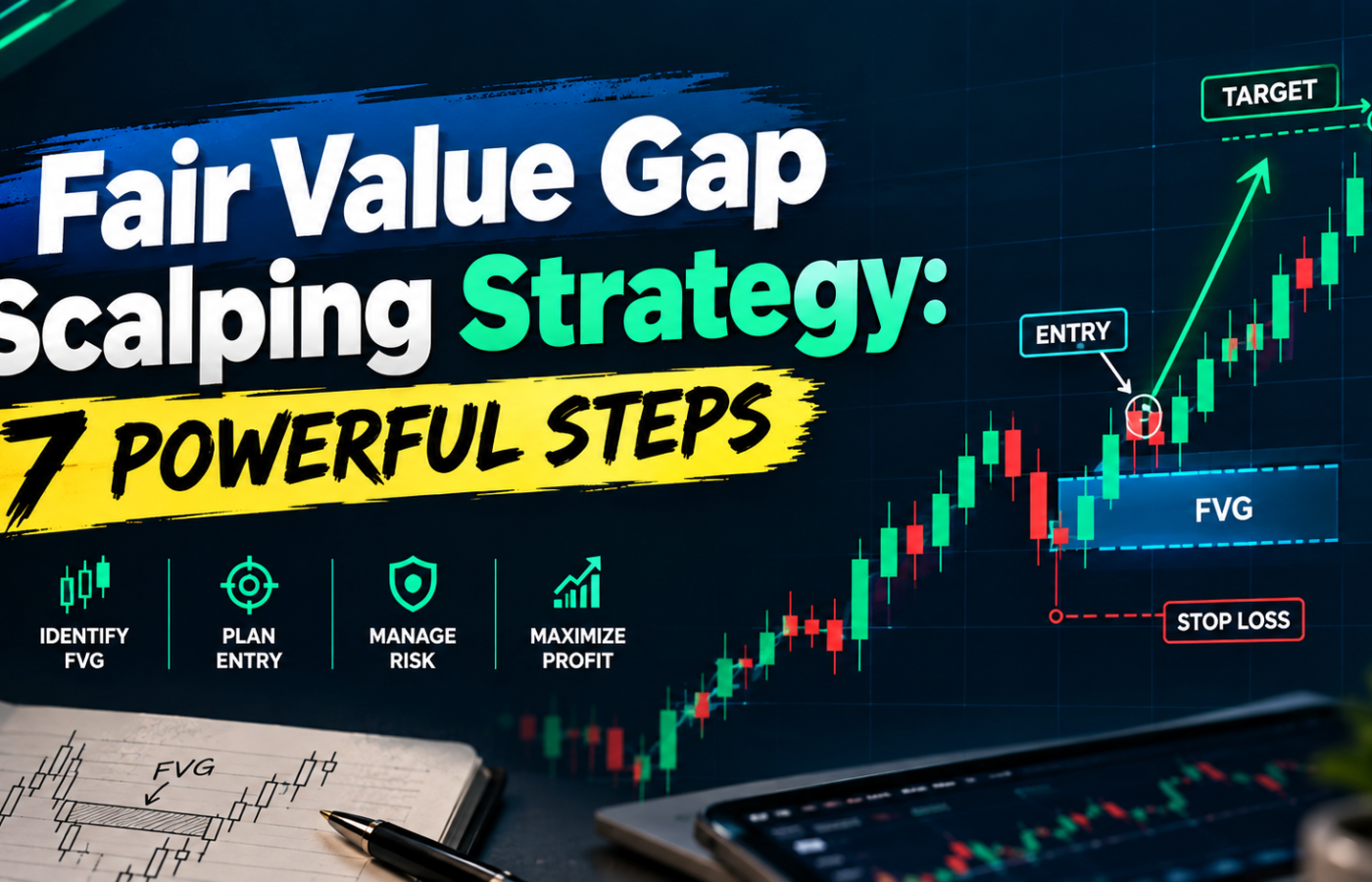
Fair Value Gap Scalping Strategy: 7 Powerful Steps

Table of Contents
- What Is a Fair Value Gap Scalping Strategy?
- How the FVG Strategy Works
- Step 1: Mark the Opening Range
- Step 2: Switch to the 1-Minute Chart
- Step 3: Identify the Fair Value Gap
- Step 4: Wait for the FVG Retest
- Step 5: Look for an Engulfing Candle
- Step 6: Set Stop Loss and Target
- Step 7: Backtest the Strategy
- Bullish FVG Setup Example
- Bearish FVG Setup Example
- Common FVG Trading Mistakes
- Frequently Asked Questions
The Fair Value Gap Scalping Strategy is a price-action approach that combines an opening-range breakout with Fair Value Gaps, Order Blocks, retests, and candle confirmation.
The strategy described in the source material uses a 5-minute chart to identify the initial range and then moves to a 1-minute chart to find the actual trading setup.
The basic idea is simple:
Opening Range → Breakout → FVG Formation → FVG Retest → Confirmation → Entry → Risk Management
This approach can be studied across different markets, including futures, stocks, forex, and cryptocurrency. However, the rules and market-session timings should always be adapted to the specific market being traded.
Risk Disclaimer: This article is for educational purposes only. It is not financial advice or a recommendation to buy or sell any financial instrument. Scalping and leveraged trading can result in substantial losses.
What Is a Fair Value Gap Scalping Strategy?
A Fair Value Gap (FVG) is a price imbalance that develops during a strong directional move.
In the strategy discussed here, the trader does not simply enter whenever an FVG appears.
Instead, the FVG is combined with:
- An opening-range level
- A breakout or breakdown
- Order Block analysis
- FVG retesting
- Engulfing candle confirmation
- A predefined stop loss
- A defined risk-to-reward ratio
This creates a structured approach instead of relying on a single indicator.
How the FVG Scalping Strategy Works
The strategy can be broken down into seven major steps.
Step 1
Identify the relevant opening range on the 5-minute chart.
Step 2
Move to the 1-minute chart.
Step 3
Wait for price to break the opening-range high or low and identify an FVG.
Step 4
Wait for price to return and retest the FVG.
Step 5
Look for an engulfing candle or other confirmation described by the setup.
Step 6
Define the entry, stop loss, and target.
Step 7
Backtest the complete setup before considering live trading.
Let’s examine each step in detail.
Step 1: Mark the Opening Range on the 5-Minute Chart
Start by opening a 5-minute chart.
The strategy described in the source uses the opening session to establish important reference levels.
The relevant 5-minute candle’s:
- High
- Low
are marked on the chart.
These levels then become the reference points for the next stage of the strategy.
The source specifically describes an example involving the 9:30–9:35 EST candle, while excluding the earlier candle from the range-marking process.
Because trading sessions differ across markets and exchanges, traders should verify the correct session timing for the instrument they are analyzing.
Why Is the Opening Range Important?
The opening range provides a clearly defined area from which traders can monitor potential directional movement.
A move above the range high can provide a bullish context.
A move below the range low can provide a bearish context.
However, the strategy does not treat a simple level break as sufficient confirmation.
Step 2: Switch to the 1-Minute Chart
After marking the opening-range high and low, switch to the 1-minute timeframe.
The purpose is to observe the price action in greater detail.
At this stage, the trader waits for price to break one of the important opening-range levels.
For example:
Opening-range high breaks → Look for bullish confirmation
Opening-range low breaks → Look for bearish confirmation
The next important component is the Fair Value Gap.
Step 3: Identify the Fair Value Gap
A Fair Value Gap is generally identified using a three-candle price structure.
During a strong directional move, the relationship between the first, second, and third candles can create an imbalance between price areas.
Bullish FVG
A bullish FVG appears during strong upward price movement.
The imbalance becomes an area that the trader can monitor for a potential retracement.
Bearish FVG
A bearish FVG appears during strong downward price movement.
The same concept is applied in the opposite direction.
The key point is that the strategy does not use an FVG in isolation.
The FVG is considered after the opening-range level has been broken.
Step 4: Wait for the FVG Retest
This is one of the most important parts of the Fair Value Gap Scalping Strategy.
After the FVG forms, the trader waits for price to return to the imbalance.
This movement is called an FVG retest.
For a bullish setup, price may return to the bullish FVG before attempting to continue higher.
For a bearish setup, price may return to the bearish FVG before continuing lower.
Instead of chasing the initial breakout, the retest provides a predefined area to observe the market.
Step 5: Look for an Engulfing Candle
The source strategy adds another confirmation at the FVG retest.
The trader waits for an engulfing candle.
For a bullish setup, a bullish engulfing-type candle can indicate renewed buying pressure.
For a bearish setup, the opposite candle structure can provide bearish confirmation.
The basic sequence becomes:
Breakout → FVG → Retest → Engulfing Confirmation
Only after this sequence develops does the strategy look for the entry.
This helps separate a potential setup from a simple price movement through an FVG.
Order Blocks and FVG Trading
The strategy also discusses Order Blocks as part of the price-action analysis.
An Order Block can be used as an additional reference area around a strong market movement.
Combining an Order Block with an FVG allows traders to examine several aspects of the same price movement.
Instead of asking:
“Did an FVG appear?”
the trader can ask:
- Did the opening range break?
- Was the market direction clear?
- Did an FVG form?
- Is there a relevant Order Block?
- Did price retest the FVG?
- Did an engulfing confirmation appear?
This creates a more structured decision-making process.
Step 6: Set the Stop Loss and Target
Once the setup is confirmed, risk management becomes important.
The source strategy describes placing the stop loss around the invalidation area of the setup.
For a bullish setup, the stop can be positioned below the relevant low around the FVG area.
For a bearish setup, the logic is reversed.
The source also discusses allowing some room around important levels rather than placing a stop exactly on an obvious price point.
However, increasing stop distance also increases potential risk unless position size is adjusted.
The 3:1 Risk-to-Reward Approach
The strategy described in the source uses a 3:1 risk-to-reward ratio.
For example:
If the planned risk is:
$100
then the potential target based on a 3:1 framework would be:
$300
Another example:
- Entry: 100
- Stop Loss: 90
- Risk: 10 points
- 3:1 Target: 130
The purpose of this framework is to define the trade before entering rather than deciding the exit emotionally after the position is open.
A 3:1 risk-to-reward ratio does not guarantee profitability.
Step 7: Backtest the Fair Value Gap Scalping Strategy
Backtesting is one of the most important parts of this trading approach.
A strategy can look extremely attractive when demonstrated through a single successful example.
That does not establish how it performs across different market conditions.
Before using the strategy with real money, traders can test:
- Opening-range breakouts
- FVG formations
- FVG retests
- Engulfing confirmations
- Stop-loss outcomes
- Target outcomes
- Time taken to reach the target
- Winning trades
- Losing trades
- Different market conditions
The larger the historical sample, the more information the trader can collect about how consistently the rules behave.
Bullish FVG Scalping Setup Example
Consider a simplified example.
Suppose the opening-range high is:
100
Price breaks above 100.
A strong bullish move creates an FVG.
Instead of entering immediately, the trader waits.
Price then returns to the FVG.
An appropriate bullish engulfing confirmation develops.
The setup now contains:
Opening Range Breakout
↓
Bullish FVG
↓
FVG Retest
↓
Bullish Confirmation
↓
Long Entry
The trader then defines the stop loss and target according to the predefined risk-management plan.
Bearish FVG Scalping Setup Example
The same concept can be applied to the downside.
Suppose the opening-range low is:
100
Price breaks below the level.
A bearish FVG develops.
The trader waits for price to return to the FVG.
A bearish confirmation then appears.
The setup becomes:
Opening Range Breakdown
↓
Bearish FVG
↓
FVG Retest
↓
Bearish Confirmation
↓
Short Entry
The stop loss and target should be defined before execution.
What Is an Inverted Fair Value Gap?
The strategy also mentions an Inverted Fair Value Gap, commonly called an IFVG.
An IFVG can be considered when the original Fair Value Gap fails to hold and price moves through the imbalance in the opposite direction.
This is important because traders should not assume that every FVG will act as support or resistance.
A failed setup needs to be recognized as part of the risk-management process.
Scalping vs Day Trading
The source describes two ways of approaching the setup.
| Scalping | Day Trading |
|---|---|
| Smaller price movements | Larger price movements |
| Faster trades | Longer-duration trades |
| More focused on quick moves | Focused on capturing larger moves |
| Source example: 10–20 points | Source example: 50–80 points |
These figures are examples from the supplied strategy and should not be interpreted as universal targets for every market.
Common Mistakes in FVG Scalping
1. Entering on Every FVG
Not every FVG is a trading opportunity.
The strategy uses additional conditions to filter the setup.
2. Chasing the Breakout
Entering immediately after a breakout can expose the trader to false breakouts.
The described method waits for the FVG and retest.
3. Ignoring the Opening Range
The opening-range levels are an important part of the strategy.
4. Moving the Stop Loss
Changing the stop because the trade is moving against you can invalidate the original risk plan.
5. Ignoring Position Size
A wider stop requires appropriate position sizing.
6. Skipping Backtesting
A strategy should be tested across many historical examples before conclusions are drawn about its performance.
Fair Value Gap Scalping Strategy Checklist
Before considering a setup, use this checklist:
☐ Mark the relevant opening-range high and low
☐ Move to the 1-minute chart
☐ Wait for a range breakout or breakdown
☐ Identify the FVG
☐ Check the relevant Order Block
☐ Wait for the FVG retest
☐ Look for engulfing confirmation
☐ Define the entry
☐ Define the invalidation/stop-loss level
☐ Calculate the target
☐ Maintain the planned risk-to-reward ratio
☐ Record the trade for backtesting
Frequently Asked Questions
What is a Fair Value Gap in trading?
A Fair Value Gap is a price imbalance identified through a three-candle structure during a strong directional movement.
What timeframe is used in this FVG strategy?
The strategy uses a 5-minute chart for the initial range and a 1-minute chart for detailed price-action confirmation.
What is an FVG retest?
An FVG retest occurs when price returns to a previously formed Fair Value Gap after the initial directional movement.
What is an Order Block?
An Order Block is a price-action reference area associated with a significant directional market movement. In this strategy, it is used alongside the FVG rather than as a standalone signal.
What is the risk-to-reward ratio used in this strategy?
The source describes a 3:1 risk-to-reward framework.
Can this strategy be used for day trading?
Yes. The source describes both scalping and day-trading applications, with different objectives for the size of the expected market move.
Does an FVG guarantee a winning trade?
No. An FVG is a technical price-action concept, not a guarantee of future market direction or profitability.