


Nifty Option Trading: Why Stop-Loss Placement Matters

The Stop Was Tested Within a Rupee, One Minute After Entry: Why Stop-Loss Placement Matters in Nifty Option Trading
Imagine entering a Nifty option trade with a clear setup. You identify your entry, calculate your stop-loss, and place the order.
Everything looks perfect.
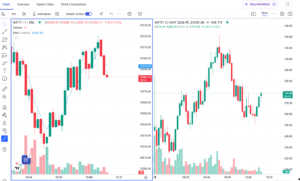
But just one minute after entering the trade, the option premium moves against you. Your stop-loss is tested within just ₹1.
For a moment, you are almost out of the trade.
This is one of the most frustrating experiences in Nifty option trading. Sometimes the market reverses immediately after testing a stop-loss level. At other times, the trade continues moving against you.
But the bigger question is not whether the stop-loss was almost hit.
The real question is: Was the stop-loss placed at the right level in the first place?
In options trading, stop-loss placement is not just about choosing a price. It is about understanding market volatility, option premium movement, entry timing, and the risk you are willing to accept.
Let’s understand why stop-l
oss placement matters so much in Nifty option trading.
1. Why Can a Stop-Loss Be Tested Within One Minute?
Nifty options can move much faster than many traders expect.
Even when Nifty itself moves only a few points, the option premium can change significantly because of delta, gamma, implied volatility, and the bid-ask spread.
This becomes particularly important in short-dated options and expiry-day trading.
Imagine a trader buys a Nifty Call at ₹150 and places a stop-loss at ₹140.
Within one minute, the premium falls to ₹141.
The trader is suddenly just ₹1 away from the stop-loss.
This can happen because of:
- A sudden movement in Nifty.
- A quick reversal near resistance.
- Increased option premium volatility.
- A widening bid-ask spread.
- Low liquidity in a particular strike.
- Changes in implied volatility.
A stop-loss can be tested very quickly even when the underlying index movement appears relatively small.
2. The Biggest Mistake: Placing a Stop-Loss Without Studying Volatility
Many traders decide their stop-loss based on a fixed percentage.
For example:
- Entry premium: ₹150
- Stop-loss: ₹135
- Maximum planned premium loss: ₹15
Although this approach is simple, it does not always reflect the actual market conditions.
An option that normally moves ₹2 or ₹3 in a minute behaves differently from one that regularly fluctuates ₹8 or ₹10.
A fixed stop-loss may be too tight during volatile conditions and unnecessarily wide during calmer conditions.
Before selecting a stop-loss, traders should consider the recent movement of the option premium and the underlying Nifty index.
The objective is to place the stop where the original trading idea becomes invalid, while keeping the potential loss within an acceptable limit.
3. Should You Place a Stop-Loss on Nifty or the Option Premium?
This is an important question for option buyers.
There are two commonly used approaches.
Underlying-Based Stop-Loss
In this method, the trader identifies a level on the Nifty index chart.
For example, a trader buys a Call after Nifty breaks above an important resistance level.
If Nifty falls back below that breakout level, the trading idea may become invalid.
The trader uses the underlying index level as the basis for exiting the option position.
Advantage: The stop-loss is connected to the actual market structure rather than only the option premium.
Limitation: The corresponding option premium can still fluctuate because of changes in volatility, delta, and liquidity.
Premium-Based Stop-Loss
In this method, the trader places a stop-loss directly on the option premium.
For example:
- Call entry: ₹150
- Stop-loss: ₹135
- Risk per unit: ₹15
This approach is easy to understand and can help traders calculate their position size.
However, a sudden premium fluctuation or bid-ask spread can trigger an exit even when the underlying market structure has not changed significantly.
Neither method is perfect. The appropriate approach depends on the trading strategy, liquidity, execution conditions, and risk management plan.
4. Why a Very Tight Stop-Loss Can Create Problems
Many beginners believe that a smaller stop-loss automatically means better risk management.
But that is not always true.
Suppose a trader buys a Nifty Put at ₹120 and places a stop-loss at ₹115.
The option premium briefly drops to ₹116 before recovering to ₹135.
The trader may exit with a small loss and then watch the same option move in the expected direction.
This experience can create frustration and encourage emotional re-entry.
A stop-loss that is too tight relative to normal market fluctuations may result in repeated exits.
However, making the stop-loss wider without adjusting position size can create an even bigger problem.
The solution is not simply to use a wider stop.
The solution is to understand the market’s normal fluctuations and calculate position size accordingly.
5. The Importance of Position Sizing
Stop-loss placement and position sizing should always work together.
Consider this hypothetical example:
| Particular | Value |
|---|---|
| Option Entry | ₹150 |
| Stop-Loss | ₹135 |
| Risk Per Unit | ₹15 |
| Lot Size | 75 |
| Maximum Planned Loss | ₹1,125 |
The calculation is:
₹15 × 75 = ₹1,125
This is the planned gross loss if the position exits at ₹135, excluding brokerage, taxes, slippage, and execution differences.
If a trader wants to increase the stop-loss distance, the position size should be reconsidered.
A wider stop with the same number of lots means more money is at risk.
Never choose your stop-loss first and ignore the amount of capital exposed.
Both decisions must be made together.
6. Why Expiry-Day Traders Need Extra Caution
Nifty expiry trading can be particularly challenging because option premiums may react sharply to small movements in the underlying index.
Near expiry:
- ATM options can have high gamma sensitivity.
- Time value can decay rapidly.
- Implied volatility can change.
- Premium fluctuations can become aggressive.
- Bid-ask spreads can affect actual execution.
This means a stop-loss that worked during normal market conditions may behave differently near expiry.
A trader should avoid assuming that a ₹5 or ₹10 premium movement has the same meaning in every option contract.
Market conditions matter.
7. What Should You Do When Your Stop-Loss Is Tested but Not Hit?
This is where trading discipline becomes important.
Imagine your entry is ₹150, your stop-loss is ₹140, and the premium falls to ₹141 before recovering.
You are still in the trade.
What should you do?
First, avoid changing your stop-loss simply because the market came close to it.
Instead, evaluate:
- Is the original trading setup still valid?
- Has Nifty broken an important support or resistance level?
- Is the option premium moving because of normal volatility?
- Has the bid-ask spread widened?
- Does the original risk-reward calculation still make sense?
If your original setup remains valid, follow your predefined trading plan.
If the setup has become invalid, exit according to your rules.
Do not move the stop-loss farther away just to avoid accepting a loss.
8. Avoid Re-Entering Immediately After a Stop-Loss
One of the most common mistakes in intraday option trading is immediate re-entry after a stop-loss.
A trader gets stopped out of a Call and immediately buys another Call because the market starts moving upward again.
Sometimes this works.
But repeated re-entry without a fresh setup can turn a manageable loss into a much larger one.
Before entering again, wait for a new trading signal.
A new trade should have its own entry, stop-loss, position size, and exit plan.
Remember, the market does not owe you a recovery trade.
9. A Practical Stop-Loss Checklist for Nifty Option Buyers
Before placing your next Nifty Call or Put trade, check the following:
- Have I identified an important Nifty support or resistance level?
- Is my entry based on a confirmed setup?
- Have I considered recent option premium volatility?
- Is my stop-loss based on a logical invalidation point?
- Have I calculated the maximum possible planned loss?
- Is my position size appropriate?
- Have I considered liquidity and bid-ask spreads?
- Am I prepared to accept the loss without moving my stop?
If you cannot answer these questions, reconsider the trade.
A few minutes of preparation can prevent unnecessary trading mistakes.
10. Final Thoughts: A Good Stop-Loss Protects Your Trading Capital
The stop-loss being tested within just ₹1, one minute after entry, is a reminder of how quickly Nifty option premiums can move.
It also highlights an important lesson: a stop-loss should not be selected randomly or placed only because a trader wants to limit the loss to a convenient number.
It should be connected to the trading setup, market volatility, option behaviour, and position size.
Sometimes a stop-loss will be triggered just before the market reverses. That is part of trading.
The objective is not to avoid every losing trade.
The objective is to make sure that losses remain manageable and that one unexpected market movement does not damage your trading capital.
In Nifty option trading, a good entry matters. But a well-planned stop-loss can matter even more.
Trade with a plan, respect your risk limits, and never let the desire to be right become bigger than your responsibility to protect your capital.
Disclaimer: This article is for educational and informational purposes only. It is not investment advice or a recommendation to buy or sell any financial instrument. Options trading involves substantial risk. Stop-loss orders may execute at prices different from the trigger price because of gaps, volatility, liquidity, and slippage.