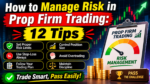

How to Manage Risk in Prop Firm Trading: A Complete Guide

Prop firm trading has become a popular option for traders who want to access larger trading accounts without putting up the entire amount of trading capital themselves. However, getting access to a funded account is only one part of the journey. The real challenge is protecting the account, following the firm’s rules, and maintaining consistent trading discipline.
Many traders fail prop firm challenges not because they cannot identify market opportunities, but because they take excessive risks, overtrade after a loss, or misunderstand the firm’s drawdown limits.
Effective risk management helps traders approach the market with a clear plan rather than making emotional decisions. Whether you trade forex, indices, commodities, or other permitted instruments, understanding how to control risk is essential.
In this guide, we will explore practical ways to manage risk in prop firm trading, protect your account, and develop a more disciplined trading routine.
What Is Risk Management in Prop Firm Trading?
Risk management is the process of controlling how much money you could lose on a trade or over a trading session. In prop firm trading, it also means understanding the firm’s specific rules regarding maximum daily loss, overall drawdown, permitted strategies, and other account restrictions.
Unlike a personal trading account, a prop firm account may have strict limits that determine whether you can continue trading. A single oversized position or a series of poorly managed trades could breach those limits.
For example, a firm might set a maximum overall loss of 10% and a daily loss limit of 5%. These figures are illustrative only; actual rules vary between firms and account types.
The goal is not to eliminate every losing trade. Losses are a normal part of trading. The goal is to ensure that individual losses and losing streaks do not put the account at unnecessary risk.
1. Understand Your Prop Firm’s Rules Before Trading
Before placing your first trade, read the firm’s current trading rules carefully. Do not rely only on promotional material or another trader’s experience, because rules can differ across programs.
Pay particular attention to the following:
- Daily loss limit: The maximum loss allowed within the firm’s defined daily calculation period.
- Maximum overall drawdown: The total loss permitted before the account breaches its limits.
- Static or trailing drawdown: Whether the loss threshold stays fixed or moves according to the account’s performance.
- Open-position losses: Whether unrealized losses count toward the limit.
- News trading restrictions: Whether trading around major economic announcements is permitted.
- Overnight and weekend rules: Whether positions can remain open outside normal trading hours.
- Position and strategy restrictions: Any rules involving lot sizes, automated trading, copy trading, or holding periods.
Also check how the firm calculates its daily reset, account equity, commissions, swaps, and floating profit or loss.
A trader who misunderstands the drawdown calculation can breach an account even when the trading strategy itself appears reasonable.
2. Risk Only a Small Percentage Per Trade
One of the most useful risk-management practices is keeping the amount at risk on each trade relatively small.
Some traders choose to risk 0.25% or 0.5% of their account equity per trade. These are examples, not universal rules. The appropriate amount depends on the firm’s limits, the strategy’s performance, market volatility, and the trader’s experience.
Suppose a hypothetical funded account has a nominal balance of $50,000.
| Risk per trade | Dollar risk |
|---|---|
| 0.25% | $125 |
| 0.50% | $250 |
| 1.00% | $500 |
At a 1% risk level, four full losses would total $2,000 before additional costs or slippage. At 0.5%, the same four losses would total $1,000.
Smaller risk per trade can provide more room to handle a losing streak. However, the nominal account balance is not the only number that matters. If the firm’s remaining drawdown allowance is small, even a seemingly modest position may be too risky.
Practical tip: Calculate your risk based on the remaining loss allowance as well as the account balance.
3. Calculate Position Size Before Entering
Position sizing determines how much exposure you take in a trade. It should be based on your planned stop-loss and acceptable monetary risk, rather than choosing a lot size based on how confident you feel.
A basic formula is:
Position size = Amount at risk ÷ Loss per unit at the stop-loss
For example, assume you are willing to risk $100 on a trade. Based on your instrument and stop-loss distance, each unit of position size would lose $20 if the stop is reached.
Your theoretical position size would be:
$100 ÷ $20 = 5 units.
This is a simplified example. Actual sizing depends on the instrument’s contract specifications, tick or pip value, account currency, commissions, and other costs.
Always verify the calculation before placing an order. A stop-loss does not guarantee the exact exit price during fast markets, gaps, or periods of low liquidity.
4. Protect the Daily Loss Limit
Daily loss limits are particularly important in prop firm challenges and funded accounts.
A trader may begin the day with a clear strategy but lose discipline after the first or second losing trade. Continuing to trade in an attempt to recover the loss can lead to a much larger drawdown.
A useful approach is to establish a personal daily stop that is comfortably below the firm’s official limit.
For example, if a hypothetical firm allows a daily loss of $1,500, a trader might decide to stop for the day after losing $600. This creates a buffer between the trader’s own limit and the firm’s breach threshold.
The correct buffer depends on the firm’s calculation method and your circumstances. It should account for open trades, commissions, and the possibility of slippage.
Once your personal daily stop is reached, stop trading. Do not increase risk simply because the market appears to offer one more opportunity.
5. Avoid Revenge Trading After a Loss
Revenge trading happens when a trader tries to recover losses quickly by entering additional trades without proper analysis.
It often begins with thoughts such as:
- “I only need one good trade to recover.”
- “The next setup cannot fail.”
- “I should increase my lot size to make the money back.”
- “I am close to passing the challenge, so I need to push harder.”
These thoughts can encourage oversized positions and impulsive decisions.
The solution is to create rules before emotions take control. Decide how many trades you may take in one session, how much you can lose in a day, and when you will stop trading.
After a significant loss, step away from the screen and review the trade later. The purpose is to evaluate whether the loss came from a valid strategy, poor execution, or a failure to follow your plan.
One losing trade does not require immediate recovery. Protecting the account is more important than trying to finish every session in profit.
6. Maintain a Realistic Risk-to-Reward Ratio
Risk-to-reward describes the potential loss compared with the potential profit on a trade.
For example, if you risk $100 to target $200, the planned risk-to-reward ratio is 1:2.
A favourable ratio can help a strategy remain viable, but it does not guarantee profitability. The win rate, trading costs, slippage, and quality of execution also matter.
Consider two simplified examples:
- A trader risks $100 to make $200 and wins 40% of trades.
- Another trader risks $100 to make $100 and wins 60% of trades.
Before costs, the first example has an expected result of $20 per trade, while the second has an expected result of $20 per trade as well.
This demonstrates why a risk-to-reward ratio should not be evaluated in isolation. A realistic trading plan needs a tested edge, not just a large profit target.
Avoid moving your take-profit farther away simply to improve the apparent ratio. Targets should be based on your strategy and market conditions.
7. Be Careful During High-Impact News Events
Major economic announcements can create sudden price movements, wider spreads, and increased slippage.
Examples include central bank interest-rate decisions, inflation reports, employment data, and major economic releases.
For prop firm traders, the risks may be greater if the firm has specific news-trading restrictions or if the account is close to a drawdown threshold.
Before trading around an announcement:
- Check the firm’s current news-trading policy.
- Identify whether the instrument you trade is affected by the event.
- Consider whether your stop-loss could be affected by a sudden price gap.
- Reduce exposure or stay out if the risk is outside your plan.
Do not assume that every firm allows the same news strategies. A trade can be profitable and still violate a firm’s rules if the strategy is restricted.
8. Avoid Overtrading
Overtrading occurs when you take too many trades, often because you feel pressure to make money or pass a challenge quickly.
More trades do not automatically produce better results. Every additional trade introduces risk, transaction costs, and the possibility of making a decision outside your strategy.
Instead, define the conditions that qualify as a valid setup. If the market does not meet those conditions, wait.
A useful daily routine may include:
- Reviewing the economic calendar.
- Marking important price levels.
- Identifying the market conditions your strategy requires.
- Setting a maximum daily loss and trade count.
- Reviewing your decisions after the session.
Patience is a practical risk-management tool. Sometimes the best decision is not to trade.
9. Monitor Total Exposure Across Multiple Trades
Opening several positions does not necessarily mean you are diversifying risk.
For example, trading multiple indices that tend to move together may create overlapping exposure. If the market moves against those positions, several trades could lose money at the same time.
Before opening another position, consider:
- Whether it is highly correlated with your existing trades.
- The combined loss if all stop-losses are trigg